
How AI Automation and CRM Systems Are Transforming Lead Generation and Sales
Businesses no longer compete on product or price alone, they compete on speed. The company that identifies, engages, and converts a prospect first usually wins the deal.
That’s exactly why lead generation has evolved. It’s no longer about collecting names in a spreadsheet; it’s about building a connected system where artificial intelligence (AI), automation, and a CRM work together to capture, qualify, and nurture every prospect automatically.
Traditional lead generation, manual prospecting, endless spreadsheets, and disconnected sales tools simply can’t keep up as a business scales. Leads slip through the cracks, follow-ups get delayed, and sales reps spend more time on data entry than on actual selling.
AI automation and CRM technology solve this problem. Together, they let businesses capture leads, qualify prospects, personalize conversations, automate follow-ups, and manage the entire pipeline from a single connected system.
What Is AI-Powered Lead Generation?
AI-powered lead generation uses artificial intelligence to identify potential customers, engage them in real time, collect key information, and determine which leads are most likely to convert.
Instead of relying entirely on sales reps to manage every touchpoint, AI takes on the repetitive, time-sensitive work. For example:
- A website visitor lands on your site.
- An AI chatbot greets them, asks qualifying questions, and collects their contact details.
- That lead is instantly pushed into your CRM.
- Automation triggers a personalized follow-up while your sales team gets full context before they even make contact.
The result? A connected lead generation engine instead of scattered, disconnected activities.
7 AI Lead Generation Ways Every Business Should Use in 2026
Here are seven practical AI lead generation ways businesses are using right now to strengthen their sales pipeline.
1. AI-Powered Website Conversations
AI chatbots engage visitors the moment they land on your site not waiting for a form submission. For service businesses, this means qualifying prospects instantly based on budget, location, timeline, or project needs.
2. Automated Lead Qualification
Not every lead carries equal value. AI analyzes prospect data against your business criteria, prioritizing high-value leads for your sales team while routing lower-quality leads into automated nurturing.
3. Intelligent Lead Routing
As soon as a new prospect enters your system, automation decides where they should go; based on:
- Industry
- Geographic market
- Product or service interest
- Lead quality score
- Company size
- Specific customer requirements
This means reps respond to the right prospects, without manually sorting every inquiry.
4. Personalized Follow-Ups
Generic emails get ignored. AI uses CRM data and prior interactions to craft follow-ups that actually feel relevant to each prospect boosting open rates and replies.
5. Predictive Lead Scoring
AI evaluates engagement signals website visits, email opens, response times to score leads by buying intent, so your team focuses on the opportunities most likely to close.
6. Automated Customer Engagement (24/7)
AI keeps conversations going outside business hours, which is critical for companies serving customers across multiple time zones. Prospects get an instant response instead of waiting until the next business day.
7. Sales Data Analysis
AI continuously analyzes pipeline activity, conversion trends, and lead behavior surfacing which channels and campaigns actually generate quality opportunities.
How Lead Generation Automation Transforms the Sales Process
Lead generation automation goes far beyond capturing a name and email address. A modern automated system connects every stage of the customer journey:
Visitor → AI Conversation → Lead Qualification → CRM → Lead Scoring → Follow-Up → Sales Appointment → Conversion
Picture this: a potential customer finds your business through search, chats with your AI assistant, and shares their contact details. The system automatically creates a CRM record, assigns the lead to the right salesperson, sends a confirmation message, schedules a follow-up, and updates the pipeline; all without any type of manual effort.
Your sales rep starts the conversation with full context, not a blank contact card. That’s the real advantage of automation: your team spends less time managing processes and more time closing deals.
The Role of CRM Lead Management
Capturing a lead is only step one. Businesses also need a structured way to organize and act on that information; this is where CRM lead management comes in.
A CRM centralizes every prospect and customer interaction in one place, instead of scattering data across spreadsheets, inboxes, and separate disconnected apps. Strong CRM lead management helps you:
- Track every lead across the entire sales pipeline
- Log every customer interaction automatically
- Monitor follow-up activity in real time
- Assign leads to the right sales rep instantly
- Flag inactive or stalled prospects
- Measure conversion rates accurately
- Analyze overall pipeline performance
- Maintain a complete customer history
When AI and automation are layered on top of your CRM, it stops being a static database and becomes a system that tells you what to do next: assign the lead, send a notification, trigger a follow-up, or move the prospect to the next pipeline stage.
CRM Sales Automation: Turning Leads Into Revenue
CRM sales automation eliminates the repetitive admin work that eats into your sales team’s day by updating records, sending follow-ups, scheduling calls, and moving deals between stages.
Here’s what a fully automated pipeline looks like:
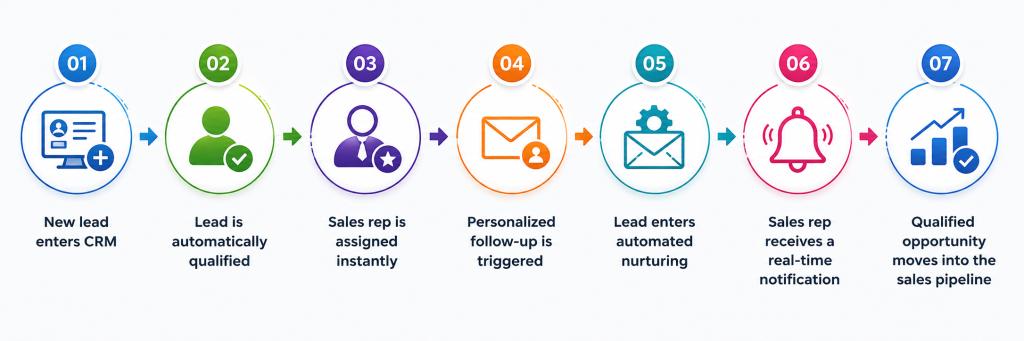
This structure creates consistency, prevents leads from falling through the cracks, and gives businesses a repeatable and reliable sales process that scales as lead volume grows.
Automated Lead Nurturing: Keep Prospects Engaged Until They're Ready
Not every prospect is ready to buy today and that’s absolutely fine. Some are still researching. Others need more information before committing. This is exactly why automated lead nurturing is a core part of modern lead generation.
AI makes these sequences smarter by using behavioral and CRM data to determine which message is most relevant at each stage replacing generic blasts with genuinely personalized nurturing.
How Lead Management Software Powers AI Automation
Modern lead management software is the foundation of an automated sales ecosystem but its real value comes from integration. When your lead management platform connects with your:
- Website
- AI chatbot
- CRM
- Email platform
- Scheduling tools
- Marketing platforms
- Customer support software
- Internal business apps
The information flows automatically between each and every system. A lead generated through your AI chatbot lands directly in your CRM with no manual data entry and no lag time. From there, automation assigns the prospect and kicks off the right nurturing sequence immediately.
For businesses running complex tech stacks, this is where custom software integrations and workflow automation make the biggest difference.
AI Sales Automation Services for Growing Businesses
As a business scales, buying another standalone software tool rarely fixes the underlying problem. Every company has unique workflows, legacy systems, and industry-specific requirements which is exactly why AI sales automation services exist.
A strategic AI automation approach typically includes:
- Auditing your existing lead generation process
- Identifying repetitive, time-consuming sales tasks
- Selecting the right AI technologies for your business
- Connecting your CRM with other core systems
- Designing automated workflows around your sales process
- Implementing AI-powered customer conversations
- Measuring performance and ROI
- Continuously optimizing the system over time
The goal isn’t to automate everything. It’s to automate the right tasks so your sales team can focus on relationships, negotiation, and high-value conversations the things AI can’t replace.
Why AI and CRM Work Better Together
AI and CRM each solve a different half of the sales equation:
- AI understands, engages, and qualifies prospects.
- CRM organizes, tracks, and manages them.
- Automation is the bridge that connects the two.
Together, they form a complete sales ecosystem:
AI Chatbot → Lead Qualification → CRM Lead Management → Automated Nurturing → Sales Notification → CRM Sales Automation → Conversion
This model is especially valuable for businesses with high lead volume, longer sales cycles, or multiple customer touchpoints including real estate, healthcare, e-commerce, education, logistics, marketing agencies, finance, consulting, startups, and enterprise teams.
The Future of Lead Generation Is Connected
The future of lead generation isn’t about generating more leads. It’s about generating better leads and managing them more intelligently.
Businesses that combine AI, CRM, and automation build systems where prospects are captured, qualified, nurtured, and routed with minimal manual work while sales teams get full pipeline visibility and can focus their energy where it counts.
If you’re exploring AI adoption, don’t start with “which chatbot should I buy?” Start by mapping your entire customer journey and identifying where AI, automation, CRM, and integrations can create measurable impact.
Ready to Build Your Connected Sales System?
Digital Crafters AI helps businesses design connected, revenue-driving solutions using AI chatbots, conversational AI, CRM sales automation, workflow automation, custom software integrations, and AI strategy consulting.
We help you move from fragmented lead management to a smarter, more scalable approach to sales growth. Get in touch with Digital Crafters AI today to see how AI and CRM can transform your tedious sales process into a seamless, automated experience.
Frequently Asked Questions
What is AI-powered lead generation?
It’s the use of AI tools like chatbots and predictive scoring to identify, engage, and qualify potential customers automatically, feeding qualified leads directly into your CRM.
How does CRM sales automation save time?
It automates repetitive tasks like lead assignment, follow-up emails, pipeline updates so sales reps spend more time selling and less time on administrative work.
Is automated lead nurturing effective for long sales cycles?
Yes. Automated nurturing sequences keep prospects engaged with relevant content over weeks or months, so leads stay warm until they’re ready to buy.
Do small businesses need AI sales automation services?
Any business handling a growing volume of leads can benefit from this. Automation prevents leads from being missed and creates a repeatable process that scales alongside the business.