
What Is an AI Chatbot for Lead Generation?
An AI chatbot for lead generation is a conversational software tool embedded on a website that engages visitors in real time, identifies their intent, answers their questions, and collects qualifying information before routing them to sales or nurturing workflows.
Unlike a static contact form, an AI chatbot adapts its questions based on what a visitor says, which lets it qualify leads the way a sales rep would on a discovery call. This shift toward conversational engagement is measurable: in HubSpot’s research on AI adoption in marketing, B2B marketers using chatbots in their demand-generation programs reported meaningful gains in both audience understanding and lead volume, with many citing chatbots specifically as a driver of new lead generation.
Why Traditional Lead Capture (Forms, Phone Numbers) Falls Short
Traditional lead generation methods place the burden of initiative on the visitor:
- Contact forms collect only a name and email, with no context on intent or fit.
- Static CTAs (“Contact Us,” “Request a Demo”) require the visitor to already be sales-ready.
- Phone numbers assume visitors are willing to make a call before getting basic answers.
Because these methods depend on the visitor acting first, businesses lose prospects who have questions but leave before finding answers.
AI chatbots remove that dependency by starting the conversation, answering questions on the spot, and guiding the visitor to the next step without requiring them to search, call, or fill out a form first.
How AI Chatbots Qualify Leads (Instead of Just Collecting Contacts)
A contact form generates a contact. A conversation generates a qualified lead. AI chatbots close that gap by asking discovery-style questions in real time, such as:
- What type of solution are you looking for?
- What business process are you trying to improve?
- Which software platforms do you currently use?
- How many users or employees will use the solution?
- When are you planning to implement it?
The chatbot uses the visitor’s answers to score fit and intent automatically, so sales teams spend time on qualified opportunities instead of manually sorting inbound inquiries. This kind of structured qualification is one of the core reasons businesses invest in ai powered chatbots development services rather than relying on a basic web form.
What Questions Should an AI Chatbot Answer on a Website?
To reduce the most common conversion barriers, an AI chatbot should be able to answer:
- What services does the company provide?
- Can the solution integrate with our existing software?
- How long does implementation take?
- Is the solution suitable for our industry?
- Can the system be customized?
- What happens after I submit an inquiry?
Answering these instantly rather than requiring a visitor to dig through service pages keeps prospects engaged and increases the odds they take a next action (booking a call, requesting a demo, submitting requirements).
How AI Chatbots Connect to CRM and Business Systems
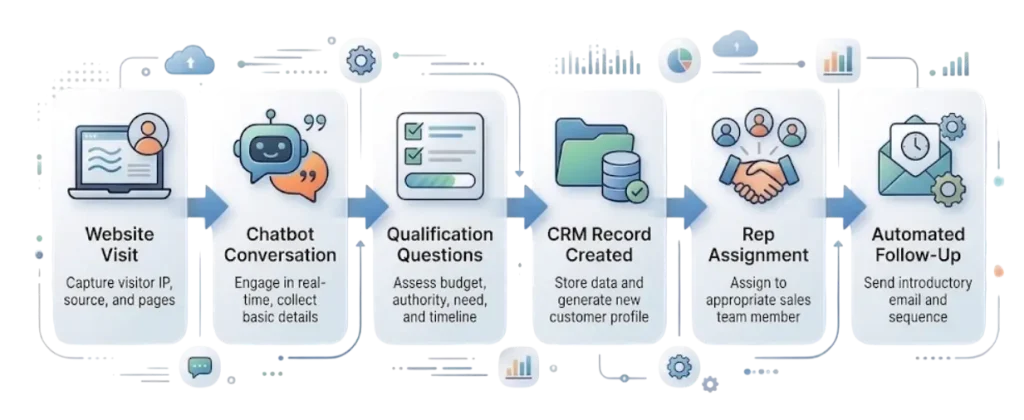
An AI chatbot becomes most valuable when it’s integrated with a CRM and other business systems, because it turns a single website conversation into structured, actionable data.
A resulting CRM record typically includes:
- Visitor contact details
- Service or product interest
- Business requirements shared in conversation
- Full chat transcript
- Qualification score or criteria met
This is achieved through custom software integration services that connect the chatbot to CRM platforms, scheduling tools, marketing automation, and internal databases. For businesses running several disconnected systems, this often falls under a broader initiative of custom software for application integration so lead data doesn’t stay siloed inside the chat widget and instead flows into the tools sales and operations teams already use.
Can AI Chatbots Be Customized by Industry?
Yes. Industry-specific chatbot design significantly improves relevance because each industry has different qualifying questions, terminology, and compliance needs. Examples:
Industry | Typical Chatbot Use Case |
Healthcare | Appointment inquiries, service information, patient engagement (within approved administrative use cases) |
Real estate | Property inquiries, scheduling viewings, buyer qualification |
E-commerce | Product recommendations, order status, return policies |
Finance | Service eligibility, consultation booking, document requests |
Education | Program information, enrollment inquiries, application status |
Logistics | Quote requests, shipment tracking, service area checks |
Agritech | Crop and pest advisories, input-product inquiries, farmer support at scale |
For healthcare organizations, ai-driven healthcare chatbot development services can be used to create tailored conversational experiences around approved business and administrative use cases, such as appointment-related inquiries, service information, and frequently asked questions.
Agritech is a smaller but fast-growing example of this same pattern. Microsoft Research’s Farmer Chat project used a generative-AI chatbot to deliver personalized agricultural advice to smallholder farmers across four countries, engaging over 15,000 farmers and answering more than 300,000 queries a useful reference point for how conversational AI can qualify and support high-volume inquiries even outside traditional B2B or e-commerce settings.
Businesses with complex or regulated sales processes generally get more value from custom AI chatbot development services than from generic, off-the-shelf chatbot platforms, since custom builds allow control over qualification logic, integrations, and data handling.
How Do AI Chatbots Identify High-Intent Visitors?
AI chatbots identify high buying intent by recognizing specific signals in conversation, such as:
- Asking about pricing
- Requesting a consultation
- Asking about implementation timelines
- Describing a specific, unsolved business problem
When these signals appear, the chatbot can automatically trigger next steps:
- Booking a consultation
- Scheduling a product demonstration
- Requesting a proposal
- Contacting a sales representative
- Submitting detailed project requirements
For larger organizations, this can be paired with enterprise workflow automation so a qualified lead automatically creates a CRM entry, gets assigned to a rep, triggers a confirmation email, and schedules a follow-up task all without manual intervention.
What Happens to Leads Who Aren't Ready to Buy Yet?
Not every qualified visitor converts immediately. AI chatbots support undecided prospects by:
- Recommending relevant case studies or resources
- Answering follow-up questions as they arise
- Keeping the conversation open instead of ending at a dead-end form
This turns “not ready yet” visitors into a nurture pipeline instead of a lost lead, letting sales focus on prospects showing stronger, near-term buying signals.
Why Custom AI Chatbot Development Delivers More Value Than Off-the-Shelf Tools
Off-the-shelf chatbots handle basic questions well, but businesses with complex sales processes usually need more flexibility than a template allows.
Custom AI chatbot development services let organizations build conversational experiences around their specific services, customers, qualification criteria, workflows, and technology stack determining exactly what the chatbot collects, how it qualifies prospects, which systems it connects with, and when conversations should transfer to a human rep.
For companies searching for AI chatbot development in Chicago, working with a local or regionally available team can also make it easier to align chatbot functionality with specific market, industry, and customer requirements. More broadly, AI powered chatbots development services combine conversational AI with APIs, CRM systems, automation platforms, and databases into one connected system.
FAQ: AI Chatbots and Website Lead Generation
Do AI chatbots actually increase lead quality, not just lead volume?
Yes because chatbots ask qualifying discovery questions in real time (use case, budget signals, timeline, current tools), the leads passed to sales include context a basic contact form never captures.
What’s the difference between a generic chatbot and a custom AI chatbot?
A generic/off-the-shelf chatbot handles basic FAQs with limited logic. A custom AI chatbot is built around a specific business’s services, qualification criteria, CRM, and workflows, and can be extended through custom software integration services to connect with existing tech stacks.
Can an AI chatbot replace a contact form entirely?
It can replace the primary lead-capture method, but many businesses keep a form as a fallback for visitors who prefer not to chat. The chatbot typically becomes the higher-converting, higher-context option.
Does adding a chatbot require rebuilding the CRM or sales process?
No. Chatbots are typically connected to an existing CRM through custom software for application integration, so lead data flows into current sales workflows rather than replacing them.
What industries benefit most from AI chatbot lead generation?
Industries with multi-step or consultative sales processes B2B software, healthcare services, real estate, finance, education, and even agritech tend to see the largest gains, since visitors in these categories usually have several questions before contacting sales or making a purchase decision.
Conclusion
Website visitors rarely convert just because they landed on the right page they convert when their questions get answered and the next step feels obvious. That’s the gap an AI chatbot closes. Instead of waiting for a visitor to fill out a form or make a call, it starts the conversation, answers questions in real time, and qualifies prospects the way a sales rep would.
The real value shows up when the chatbot isn’t working in isolation. Connected to a CRM through custom software integration services, paired with enterprise workflow automation for routing and follow-up, and built around a business’s actual sales process through custom AI chatbot development services, a chatbot stops being a support widget and becomes a functioning part of the pipeline one that qualifies leads, feeds sales the context it needs, and keeps low-intent visitors in a nurture loop instead of losing them altogether.
Whether it’s a healthcare provider using AI-driven healthcare chatbot development services for appointment-related inquiries, an agritech platform scaling farmer support, or a growing business exploring AI chatbot development in Chicago, the underlying principle is the same: a chatbot that understands intent and connects to the right systems turns website traffic into qualified, sales-ready opportunities not just more contacts in a database.