
Every business wants the same outcome: turn strangers into customers, faster and more predictably. The challenge is that most sales funnels leak at the seams: leads go cold at the top, warm prospects get forgotten in the middle, and ready-to-buy leads stall at the bottom because follow-up was too slow. This is exactly the gap AI is built to close. When businesses talk about wanting to automate sales funnel activity end to end, they’re really asking one question: how do you keep every stage of the buyer journey from that very first spark of awareness through active consideration to the final decision moving without dropping the ball at the handoffs?
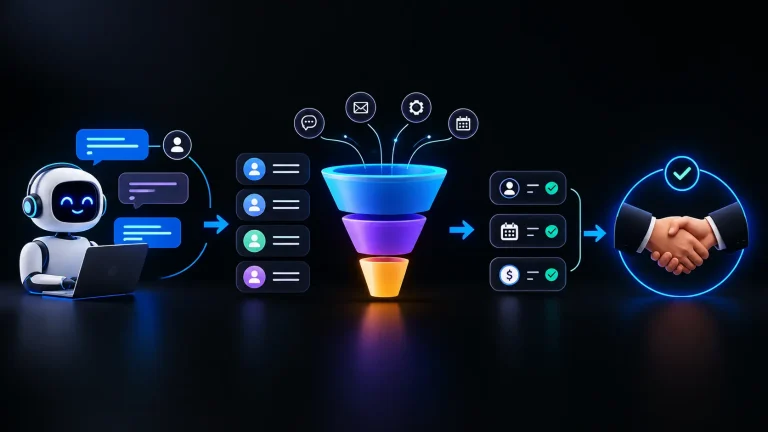
This article breaks the funnel into its three practical stages and looks at what AI actually changes at each one, from the first conversation a prospect has with your brand to the moment a deal closes. The businesses getting the most out of this shift aren’t necessarily adding more tools they’re connecting the tools they already have so that a lead captured at the top of the funnel isn’t lost by the time a lead reaches the bottom.
Where AI Starts the First Conversation
At the top of the funnel, prospects don’t know your brand yet they’re searching for answers to a problem, not evaluating vendors. The old approach was a static contact form and a slow follow-up. The new approach is a real-time conversation the moment someone lands on your site.
This is where conversational AI software solutions have changed the economics of awareness-stage engagement. Instead of visitors bouncing after reading a page, an AI-powered assistant can answer questions, qualify interest, and capture context immediately. Adoption of this approach is no longer a fringe tactic; conversational AI is now used in at least one customer-facing function by 78% of global enterprises and Gartner projects. It will cut contact center labor costs by roughly $80 billion in 2026 alone as businesses shift routine, high-volume conversations away from manual handling.
Speed matters just as much as the conversation itself. Marketing funnel benchmarks show that responding to an inbound lead within five minutes makes a sales team roughly 21 times more likely to qualify that lead, compared to waiting even thirty minutes. Automating the top of the funnel isn’t about replacing human connection it’s about making sure that first conversation happens while interest is still fresh, at a volume no team could realistically handle by hand.
Where Data, Scoring, and Nurturing Take Over
Once a prospect has engaged, the middle stage of the funnel is where most deals are quietly won or lost. This is the stage where a business has to figure out who’s actually worth a sales rep’s time and this is exactly the gap that separates average funnels from great ones. Research on B2B funnel performance shows the average conversion rate from marketing-qualified lead to sales-qualified lead sits around 13–15%, compared to 39–40% for teams using behavioral lead scoring instead of gut instinct.
Getting that lift requires two things working together: automated sales CRM software that captures and organizes every interaction, and AI models that score leads based on real behavior rather than static demographic assumptions. This is where CRM and sales automation stop being two separate tools and start functioning as one connected system. Every chatbot conversation, email open, and content download automatically updates the lead’s record and adjusts its score. The impact on team capacity is substantial: CRM automation reduces administrative work by up to 80%, and businesses that keep their CRM data clean and AI-assisted report roughly 34% higher sales productivity and 42% better forecast accuracy than teams working off spreadsheets and memory.
Nurturing is the other half of this middle stage. Not every engaged lead is ready to talk to sales, and treating them all the same way one generic email sequence is one of the most common funnel mistakes. AI-driven nurturing instead adjusts content and timing based on what a lead has actually shown interest in, which is precisely the kind of personalization that modern automated sales CRM software is built to support at scale, without requiring a marketer to manually segment every list by hand.
This is also the stage where funnel alignment either pays off or quietly breaks down. If marketing’s view of a lead’s engagement doesn’t match what sales sees in the CRM, warm prospects get contacted too late or not at all. Businesses report reduced customer acquisition costs specifically when marketing and sales are working from the same automated data, rather than reconciling two separate spreadsheets after the fact. That’s the practical reason this middle stage deserves as much investment as the two stages around it, even though it’s the least visible part of the funnel to leadership.
Where AI Removes the Friction to Close
By the bottom of the funnel, a prospect has done their research and is evaluating whether to commit. This is the stage where delays cost the most; a slow follow-up here doesn’t just lose momentum, it can lose the deal outright to a competitor who responded faster.
AI’s role at this final stage is about precision and speed rather than volume. Automated systems can flag buying-intent signals a pricing page revisit, a demo request, a direct question about implementation and route that lead to a rep immediately, with full context on what the prospect has already asked and seen. That context matters because rep time is genuinely scarce: research citing Salesforce’s own sales benchmarks found that even with CRM in place, teams save 4–5 hours per week once manual data entry is automated out of their workflow, time that goes straight back into closing conversations instead of admin work.
The compounding effect shows up directly in cycle time and cost. Businesses running clean, AI-assisted CRM and follow-up automation report sales cycles running 8–14% shorter than manual processes, and companies overall report meaningfully reduced customer acquisition costs once automation replaces inconsistent manual follow-up. None of this replaces the sales conversation itself it just makes sure that when a prospect is ready to buy, nothing in the process slows them down.
Why the Funnel Doesn't Stop at "Automate Sales Funnel"
Getting awareness, consideration, and decision-stage activity working as one connected system is the goal but it’s worth being honest about what that actually requires. A chatbot alone doesn’t automate a funnel. A CRM alone doesn’t automate a funnel. The value comes from connecting engagement, scoring, nurturing, and follow-up into a single pipeline where each stage triggers the next automatically.
That’s the same underlying logic behind enterprise workflow automation more broadly. Once a business has built one connected pipeline for its sales funnel extending the same approach to onboarding, support, reporting, and internal approvals becomes a matter of adding new triggers to infrastructure that already exists, rather than building each process from scratch. This is exactly where business process automation services and dedicated workflow automation services tend to add the most value: not in automating any single task, but in designing how all the pieces hand off to each other so leads, and later customers, never fall through a gap between systems.
Bringing It All Together
The funnel hasn’t changed shape prospects still move from awareness to consideration to decision. What’s changed is how much of that movement a business can support without manual intervention at every step. AI at the awareness stage starts the conversation faster. AI in the middle stage scores and nurtures leads based on real behavior instead of guesswork. AI at the decision stage removes the friction that stalls a ready buyer.
Treated as three separate initiatives, these efforts produce marginal gains. Treated as one connected system the actual goal when a business sets out to automate sales funnel operations they compound. The businesses seeing the biggest returns in 2026 aren’t the ones with the flashiest single tool; they’re the ones that connected engagement, CRM, scoring, and follow-up into a pipeline that runs continuously, from the first conversation to the closed deal.